Raul Fattore
July 7, 2026
The present study is divided into two parts
Table of Contents
Summary of Part 1
The Universal Electrodynamic Force was the cornerstone for deriving the new Universal Electrodynamic Gravitational Force, which is the base to describe the electrodynamics of black holes. The Universal Electrodynamic Gravitational Force, based on charges, not the Newtonian masses, is proven to be the result of the neutral dipole oscillation in bodies, demonstrating that gravity is of electrodynamic origin. The new gravitational force includes a non-radial term resulting in the quantization of the orbits and redshifts. The decay in the force of gravity causes the loss of mass due to radiation loss. The quantization of masses’ organization causes quantized redshifts, where the wavelength of the gravitational radiation is predominantly in the microwave region because of the abundance of hydrogen. The new gravitational force also eliminates the need for the hypothesis of “dark matter” or “dark energy” to explain the “excess of velocity” observed in spiral galaxies. The differential equations of motion of the force explain the phenomenon in spiral galaxies, whereas the “gravitational lensing” phenomenon is explained by the interference of electromagnetic gravitational waves that can be easily reproduced in the laboratory. The phenomenon is achromatic in nature due to the almost-unity refractive index of the intergalactic plasma and vacuum.
Acronyms, Abbreviations, Keywords
BH / BHs: black hole / black holes
SR: Schwarzschild radius
EMW / EMWs: electromagnetic wave / electromagnetic waves
EMR: electromagnetic radiation
EMF: electromagnetic field
COMU: center of mass of the universe
GEMW / GEMWs: gravitational electromagnetic wave / gravitational electromagnetic waves
Abstract
The electrodynamic origin of black holes as well as the electrodynamic origin of the gravitational force developed in the present study will contribute to a better understanding of how our universe works and obeys the real-world physics demonstrated by the more than proven laws of electrodynamics.
There are many scientific articles published on black holes. Unfortunately, almost all of them lack a real-world physics approach because authors based their studies on the pseudo-physics, invalid, and faulty theory of relativity that hindered and damaged the progress of physics for more than 100 years due to the unthinking adherence of scientists to that theory.
This study presents a new perspective that will clarify and demystify many aspects about the origin of the gravitational force through a newly derived equation with terms that are absent in basic Newton’s gravitational law. It will also be demonstrated the decay of the gravitational force, the origin of black holes, what they really are, how they are formed, how they evolve, the real radiation spectrum, what particles are the constituents of black holes, what particles are to be found outside a black hole, the wavelength shift (or redshift) of black holes, and other properties.
- Do “receding” galaxies really mean that the universe is expanding?
- Is it scientifically serious to accept that gravity is not a force, but a “geometrical effect” caused by mass?
- Is it scientifically serious to accept that “geometrical gravity” lacks a unique unit of calculation, because it depends on what is being calculated?
- Can it be scientifically acceptable that a lump of Newtonian mass bends EM radiation?
- Can monochromatic radiation emission from black holes be scientifically acceptable?
- Can it be scientifically acceptable that some types of black holes do not rotate?
Based on realistic and proven universal laws of electrodynamics, the answers to these questions will naturally emerge as the current real-world study is developed.
Introduction
To gain deeper insight into the electrodynamic origin of black holes and gravitational force, the reader should be aware of some important flaws of the theory of relativity. A theory that contributed to the misinformation about how Mother Nature works.
The theory of relativity violates its basis, i.e., the tenet of relative motion. Relative motion depends on relative coordinates, not on reference frames [1]. Magnitudes measured from a relational motion will have the same value on any frame of reference. Also, the theory postulates the equivalence of inertial mass with gravitational mass. According to this theory, gravity is not a force but a curvature of space-time, i.e., a geometrical property, so that the gravitational mass is not subject to Newton’s third law. An absolute contradiction to the mass equivalence principle.
The velocity of light is not absolute, as postulated in the theory of relativity. The velocity of light depends on the relative motion between sources or between the source and detector (observer). The velocity of an EMW is only constant relative to the medium. The velocity of light obeys the principle of relative velocity addition/subtraction so that there is no speed limit in the universe. The velocity of an EMW source adds/subtracts to the wavefront speed. Otherwise, no Doppler effect or Cherenkov effect can be observed.
Another important flaw in the theory of relativity is a wrong energy equation that only depends on velocity while the acceleration of the system is not taken into account. This is especially dangerous when applied to nuclear fusion, where massive acceleration of charges exists. It means that radiation energy calculation is totally ignored [2]. The momentum change equation in the theory of relativity is also flawed because it lacks an acceleration term as well.
The absence of a real-world physical explanation of the “unusual” high velocity in the outer arms of spiral galaxies gave rise to the unphysical and absurd assertion that it is caused by “dark matter” or “dark energy.” How scientists could accept something like that is beyond understanding.
The present study is based on the universal electrodynamic force [3], from which the new gravitational law is derived. Also from the universal force, a universal total energy equation has been derived [4]. This is the first time in physics a true total energy equation has been formulated, including the classical potential energy term and kinetic energy terms depending on velocity and acceleration. A universal total momentum change equation with an acceleration term has also been derived from the universal force. These equations have been successfully applied to calculate the real released energy in nuclear fusion and the real energy of the products, as well as the discrete atomic energy levels and atomic spectra [5].
The cosmic-scale application of the universal electrodynamic force, energy, and momentum equations will be demonstrated throughout this study.
The universal electrodynamic equations are valid on any scale, from subatomic particles to cosmic dimensions.
The Electrodynamic Origin of the Force of Gravity
Before exploring the electrodynamic origin of black holes, it is necessary to understand the electrodynamic origin of the gravitational force.
Newton’s law of gravitational force has provided for many years an excellent approximation about how masses interact and continue to be useful to describe the free motion of celestial bodies, despite being an action-at-a-distance force.
The theory of relativity asserts that gravity is not a force but a deformation of the space-time “mesh” caused by mass. Space is a concept that defines the distance between objects. You cannot deform a concept. The “space-time” is just a mathematical model, not a real-world physics model.
The problems with Newton’s gravitational law and the gravitational “effects” from the theory of relativity are that neither of them can explain the tilt in the orbit of the masses around a central mass, or the orbit quantization (Titius-Bode law), or the redshift quantization, or the decay of the force of gravity, or the decay of the redshift.
Two more recent alternatives have been explored to get a more comprehensive gravitational force equation:
- Derivation of a gravitational force from Weber’s electrodynamics [6].
- Derivation of a gravitational law from the universal electrodynamic force [7].
The gravitational force derived by Assis from Weber’s electrodynamics, even though it can explain more properties than Newton’s law, is an action-at-a-distance force.
The most comprehensive and modern law of gravity was developed by Lucas from the second alternative above, derived from the universal electrodynamic force.
The Universal Electrodynamic Force
The universal force in vectorial form is:

(1)
Where , and , are the relative position, velocity, and acceleration between the two charges.
The universal force in geometrical form is:

(2)
In general, velocity and acceleration may not have the same direction. Let’s define their angles with respect to the vector .
: angle between and
: angle between and
This force is based on the relative motion of two charges, is entirely relational, and whatever relational magnitude we measure from this motion will have the same value in all frames of reference. It uses Galilean transformation based on causality. It always conserves energy and momentum, satisfies Mach’s principle, and has chiral symmetry. Furthermore, it is really relativistic because it only depends on relative coordinates instead of relative reference frames.
An Overview of the Universal Electrodynamic Force’s Terms
We know that the gravitational field cannot be shielded. It has been experimentally demonstrated by Hooper [8] that motional induced electric fields cannot be shielded, a property that is directly related to gravity. The universal force contains such a term, as detailed below.
1) First term of the Universal Force: static and velocity electric fields
The second term of this force is an induced electric field that cannot be shielded.
We can write this term as:
2) Second term of the Universal Force: radiation in any accelerated motion
This term is an acceleration electric field that contributes to the radiation in the same direction as the acceleration, making it valid for any motion.
3) Third term of the Universal Force: perpendicular and longitudinal magnetic forces
This term is the sum of the magnetic forces in the direction of and .
Ampere’s law only includes the distance-direction term () of the magnetic force between the two charges. Graneau [9] demonstrated experimentally that there is also a magnetic force in the direction of the current (“longitudinal” magnetic force). The second term of the magnetic force in the direction of is a proof of that force.
This magnetic force can be written as follows:
The first term is the classic Ampere force between two moving charges. Note that :
The second term is the velocity magnetic field force, or the “longitudinal” Ampere force:
Independent of the relative velocity , the magnetic force term will always vanish when is in the direction of (), or for as in circular motion.
4) Fourth term of the Universal Force: radiation in non-linear accelerated motion (Bremsstrahlung)
This radiation force has a term in the direction of and the other in the direction of . When both vectors are in the same direction (like in linear motion) or opposite directions (head-on motion and uniform circular motion), then this radiation force is zero.
This term accounts for the radiation force in non-linear accelerated motion. It is zero for linear accelerated motion and uniform circular motion, but non-zero otherwise. It is known as Bremsstrahlung, which also includes synchrotron radiation, cyclotron radiation, etc.
In short form:
We see that there are two terms contributing to the radiation force, namely the second and fourth terms, each valid for a certain type of motion. The full radiation force valid for any accelerated motion is given by the addition of those two terms: .
The brief overview of the universal force terms, especially that of the motional electric field that cannot be shielded (first term), gives us a solid background for the derivation of a gravitational force.
A New Approach to the Gravitational Force
The gravitational force is approximately times smaller than the static Coulomb electric force. As an example, if we consider that a free electron drift velocity in a conductor is about , then . If we look at equation (1) or (2), and consider that , it suggests that the force of gravity might be a higher order term multiplying the static Coulomb term.
Since the gravitational force is always measured between neutral bodies, the attractive force of gravity must be caused by a small residual electrodynamic force between oscillating neutral dipoles. These neutral dipoles may be protons and electrons inside a neutron, or atomic electrons interacting with nuclear protons, or any two charges of equal magnitude and opposite signs that may interact without fusing.
The derived gravitational force by Lucas [7] is:
(3)
Where:
: amplitude of oscillation of charge 1, : frequency of oscillation of charge 1
: amplitude of oscillation of charge 2, : frequency of oscillation of charge 2
It is obvious that equation (3) will hold for a wide range of amplitudes and frequencies.
The first term causes planets to orbit the sun with an elliptical orbit in the equatorial plane of the sun. The second term modifies the orbit to lie on the surface of a toroid that is centered on the equatorial plane of the sun (or central mass).
Now, comparing the first term with Newton’s gravitational law, we have:
(4)
Replacing the Newton equivalence (4) in equation (3), we get the new gravitational force equation in a more familiar way:
(5)
The first term is the radial Newton’s universal gravitational force for non-relativistic velocities. The second term is a new non-radial term that causes a helical motion and several effects, including the quantization of the gravitational force (causing quantized orbits, quantized redshifts, etc.). The strength of the second term is much less than the first due to the factor.
The orbit on the equatorial plane of the central body becomes circular in nature, while the second term gives it a helical motion that will define a toroidal shape along the orbit. In the context of the equatorial plane of the sun, for example, the orbit of the planet around the sun would seem to have a tilted ellipse shape. Thus, the new gravitational force explains the orbit inclination of masses orbiting a central mass.
A good example of the quantization of the force of gravity can be observed on the four more massive moons of Jupiter. Besides their helical motion around Jupiter, the relative periods are Io=2, Europa=4, Ganymede=8, and Callisto=16.
Effects of gravitational decay
The immediate consequence we see from equation (3) is the decay of the force of gravity. The radiation loss will cause a reduction of mass with time.
1. The amplitude of oscillation of the dipoles of celestial bodies would be larger in shells close to the surface than in the center of the celestial body, so that the radiating process will take place faster in shells close to the surface than in the center of the celestial body. Thus, the rate of decay of the force of gravity would depend on the ratio of volume to surface of the celestial body. The larger the radius, the smaller the rate of decay of the force of gravity.
2. Dipoles closer to the center of a galaxy will have slower energy loss compared to dipoles located closer to the edge of the galaxy. Dipoles in very massive astronomical objects located near the center of the universe will experience slower energy loss, while those closer to the edge of the universe will have a faster rate of energy loss.
The rate at which the gravitational force decays is dependent on the location of the object within the universe.
3. Cosmological models wrongly attribute the cracks on the surface of celestial bodies to contraction due to a cooling process, while gravity is assumed to be constant. However, what really happens is the opposite.
The decay of the gravitational force in a celestial body means its expansion. The stability is guaranteed by the natural law of energy and angular momentum conservation. We have local proof on earth with the splitting of its surface into plates to form the present continents. And this process doesn’t stop. There are countless proofs of observable surface cracks on celestial bodies like our moon, moons of other planets, planets, etc. They are caused by expansion, not contraction.
4. Hubble discovered that light from far cosmic objects has a larger redshift than light from near cosmic objects. As the gravitational force decreases with time, the energy of the cosmic object would have been greater in the past when gravity was stronger (larger mass and smaller radius). Therefore, the gravitational redshift should be larger the farthest away the cosmic object is.
On the other hand, the magnitude of the redshift depends on the size of the object. A larger object decays more slowly than a smaller one. If we have a massive object at the same distance as a smaller one, the larger object will have a greater redshift than the smaller one. A black hole (or quasar) at the center of a galaxy will have a larger redshift than the galaxy it is connected to.
Note that, since gravity decays, the magnitude of the redshift of an object will also decay over time.
5. Cosmological redshift might be the same thing as the gravitational redshift.
The theory of the “universe expansion” becomes invalid if the universe has a center. The idea of “receding galaxies” will be invalidated if everything revolves around the COMU. Galaxy clusters will have “priority” over less massive objects in finding stable orbits around the COMU because of their mass magnitude. This suggests that they will organize in quantized orbits according to the new gravitational law.
Assuming that these objects are in stable orbits, it is natural that the relative velocity among them will increase or decrease within a certain range. This does not necessarily mean that galaxies are receding or eventually coming in our direction for a collision.
If all cosmic objects rotate around the COMU, then the theory of the “universe expansion” will become invalid, and the redshift might be only due to gravity (with the added Doppler effects).
6. The organization of particles in Mother Nature obeys the universal force law that is proportional to , which means that every particle organization must have a center. Therefore, as atoms have a center, solar systems have a center, and galaxies have a center, the universe as a whole must have a center.
As we have stated before, for stability and energy balance, masses around a central mass will be organized in a specific “quantized” manner by following the new gravitational force law. This is a valid cosmic law that can be extended to galaxies, galaxy clusters, and the universe.
As a result, all redshifts that we measure will be quantized [10], [11], [12].
7. The rotation velocity of galaxies’ outer spiral arms is apparently higher than should be according to the visible mass and Newton’s law. A common explanation of this discrepancy is to assert that there is more mass that we cannot see or measure. As a consequence, the fatidic, unphysical invention of “dark matter” and “dark energy” was conceived to explain the cause.
Another way, less drastic, to match the measured data with the observed mass was the empirical approach called Modified Newtonian Dynamics (MOND). The relationship between the orbital speed of galaxies’ outer spiral arms and galaxies’ brightness also matched the MOND.
It is also confirmed that the size and luminosity of spiral galaxies are discrete or “quantized” [13]. Titius-Bode’s law appears again, as with redshifts, so we have consistency.
The explanation of the “excess of velocity” in spiral galaxies
As we have stated before, based on the newly derived universal gravitational force, the mass in the outer part of a galaxy decays faster than its mass at the center. Conservation of energy for the outer masses says that in the past, the mass of the galaxy’s center was larger.
The outer masses in the spiral galaxy are now in the phase of escaping from the galaxy whose mass was reduced to such an extent that it can no longer hold those outer masses.
In a further section we’ll derive the differential equations of motion caused by the gravitational force. The escape condition will be demonstrated, as well as how an escaping object will naturally reach a constant velocity after a certain time that exactly describes the motion of the outer masses in spiral galaxies. An example of a solution for a sun-earth system with certain initial conditions is shown in Fig. 1.
In these hypothetical conditions, we see how the earth escapes from the solar system until reaching a constant velocity after some time. Thus, there is no need for empirical equations like the Modified Newtonian Dynamics (MOND).
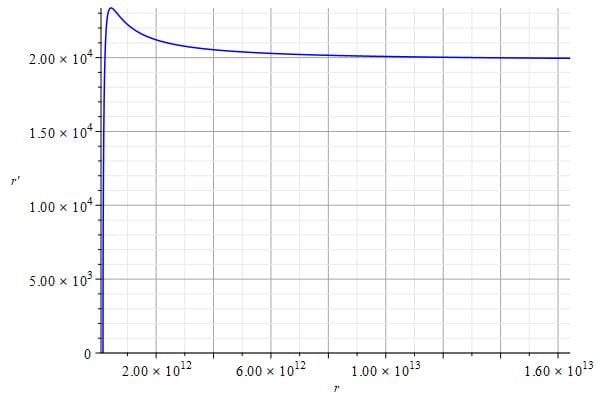
Graph of velocity vs. distance
Earth escapes from the solar system at constant velocity
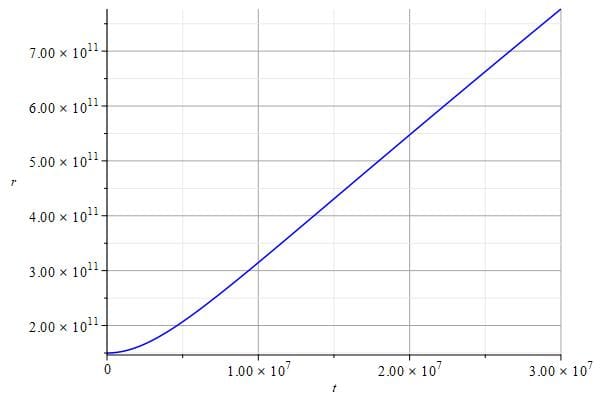
Graph of distance vs. time
Earth escapes from the solar system at constant velocity
Therefore, there is no such illogical and unphysical thing as “dark matter” or “dark energy,” but a real-world physical explanation backed by the newly derived universal electrodynamic gravitational force.
The Wavelength of the Gravitational Radiation and the Origin of the Cosmic Background Radiation
Now it is clear that the new universal gravitational force that is defined by Eq. (3) is a wave with a certain wavelength given by the dipoles’ oscillations.
From Eq. (4), assume that the two interacting bodies are composed of and atoms of atomic number and .
(6)
Since hydrogen makes about 75% of all visible matter in the universe, let’s assume that the interaction is between two hydrogen atoms. To make calculations simple, assume that , , , , . After replacing the quantities in Eq. (6):
Solving for :
(7)
The mass of the hydrogen atom is practically the mass of the proton. Replacing the proton charge and mass, assuming an average radius of the hydrogen atom of , and an estimated amplitude of oscillation of 1% of the atomic radius, we get:
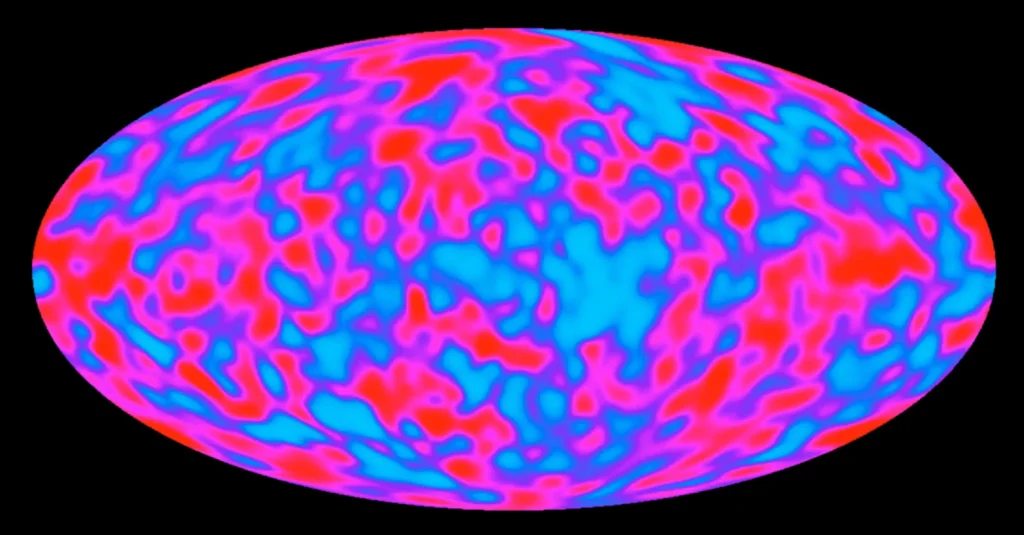
Cosmic Microwave Background (CMB) radiation (COBE NASA)
(8)
This wavelength corresponds to microwave radiation and is very close to the peak wavelength () of the cosmic background radiation as measured by the COBE satellite shown in Fig. 2.
We see that the cosmic background radiation is non-isotropic and gives us information about the mass distribution in the universe.
Most of the regular cosmic objects radiate gravitational waves within the microwave range as their main radiation, including black holes of certain sizes, as we’ll see later. Stars also do, but with less intensity.
The new derived universal gravitational force given by Eq. (3) is also capable of predicting that the cosmic background radiation is of gravitational origin.
In the study Negative Mass and Negative Refractive Index in Atom Nuclei – Nuclear Wave Equation – Gravitational and Inertial Control (Part 1), we have already demonstrated that mass is not a fundamental quantity but determined by the electrodynamic properties of particles. The newly derived universal gravitational force is another clear demonstration of the real electrodynamic origin of the lump of Newtonian mass.
The Unreal and Unphysical Idea of Space-Time Warping and the Real Origin of “Gravitational Lensing”
We have already mentioned that there is no such thing as the warping or bending of a mathematical (unphysical) model called “space-time” by a lump Newtonian mass. What we can physically bend are electromagnetic fields instead.
The wrong idea that a Newtonian mass can deform the unphysical “space-time” mesh to bend EMR is still alive in the mind of some scientists who like to believe more in an irreal world than in Mother Nature.
Do not confuse our real GEMWs with the fictitious “ripples in space-time” that do not exist as physical effects. Gravitational waves are electromagnetic waves, and space is not something mechanical that can be moved. No geometrical properties can be granted to a force of electromagnetic origin.
When a cosmic object explodes or collapses, a gravitational electromagnetic shock wave pulse of huge amplitude is generated. Cosmic explosions carry out colossal amounts of electromagnetic energy in the form of momentum. This gigantic momentum pulse will shake all cosmic objects. Then, it is absolutely natural to expect a mechanical vibration and a push on them because of the enormous radiation pressure.
We have an extremely sensitive interferometer on Earth that can detect the tail pulse of GEMWs from cosmic cataclysms. It detects the Earth vibration caused by the momentum of the pulse (radiation pressure), not the “ripples in space-time.” Still, highly sensitive seismic instruments might also be used to detect massive cosmic explosions.
Thus, gravity is an electromagnetic wave, and as such, it follows the laws of electrodynamics. The gravitational field is subject to interference, diffraction, refraction, scattering, etc. In other words, any optical effect is also valid for GEMWs.
According to the ill-fated theory of relativity, the so-called “gravitational lensing” effect is due to the light bending caused by massive cosmic objects or high concentrations of mass. If it were true, then it would be impossible to observe the rings, crosses, or semi-arcs of light in the laboratory because of the amount of mass involved.
However, a simple optical experiment in the laboratory [14] replicated exactly the same patterns that we observe in the cosmos.
The lens effect observed in the cosmos is caused by the interference of the gravitational electromagnetic waves from a cosmic object located behind another object when the gravitational electromagnetic waves pass through the latter. The patterns are visible in full or distorted, depending on the alignment of the objects with the observation point.
The refractive index of the intergalactic plasma is practically 1 (except for VLF and ULF), like the refractive index of vacuum. Therefore, the bending due to interference of the electromagnetic waves will be the same for almost all wavelengths (achromatic).
This is another demonstration of the extent of the new universal gravitational force that can explain many effects without resorting to pseudo-physical theories that preach misinformation and fantasy instead of describing the real world.
A word of caution to astronomers and astrophysicists observing our universe: beware if you are observing a cosmic object through a spiral galaxy that is perpendicular to your observation axis. The interference pattern of the obstacle spiral galaxy may generate an image similar to a binary system, which might not be the real structure behind the obstacle galaxy.
The Differential Equations of Gravitational Motion
The new universal gravitational force described in Eq. (5) can be written in geometrical form as:
(9)
Where: , , and is the angle between and . As the gravitational force is attractive, for the second term to be negative, the angle must be .
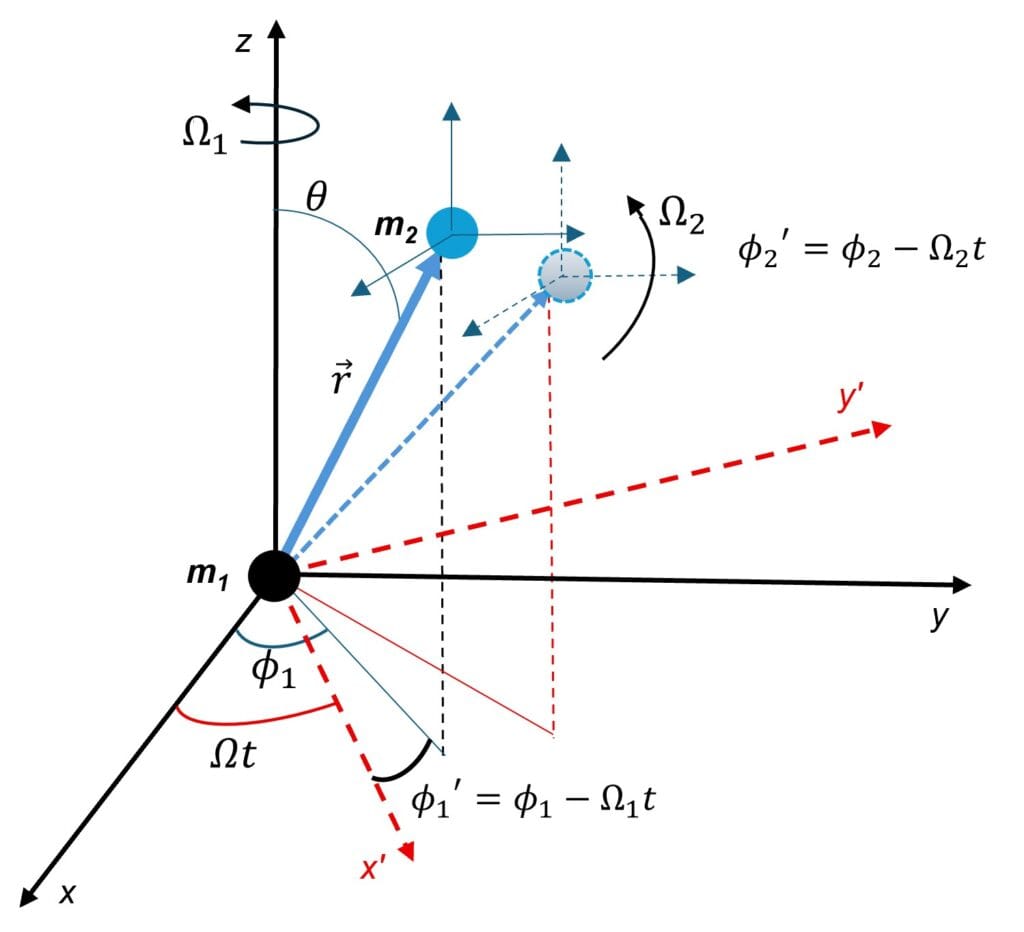
Gravitational motion between two masses
Assume that mass is at the origin of the spherical coordinate system, while is at a distance measured from the center of mass of each of the masses (see Fig. 3).
The relative azimuthal angle between both masses is , and the corresponding relative azimuthal angular velocity is . These equations are useful for setting the initial conditions when solving the differential equations.
Instead of taking the relative distance between the center of masses of the bodies, we’ll take it to be between the surfaces of the bodies. This choice will give us clearer results in cases where the bodies collide.
Now, the distance vector spanning between both surfaces will be:
(10)
Where is the radius of mass and is the radius of mass . Replacing Eq. (10), its magnitude, and derivative in Eq. (9), and also , we get an equation of the type .
The acceleration caused by on is , while the acceleration caused by on is . The relative acceleration between the 2 centers of masses is , that is, (11)
The left-hand side is . However, the acceleration equation in spherical coordinates will be the same for and . Thus, we can write . Replacing this in Eq. (11), our final equation is:
(12)
Now we have to equate the components of both sides of Eq. (12). After some algebra, we get the system of three coupled differential equations that describe the gravitational interaction between two masses:
(13)
(14)
(15)
This system will be solved numerically. We can avoid the singularity in for the initial conditions by defining a very small angle . There is also a singularity in the distance that we may avoid for the initial conditions by setting . However, there will be a point during the execution where the solver will reach one or both singularities after a certain time. Though the solution might be limited in time in some cases, the resulting graphs will be good enough to understand the evolution of the system.
Diverse solutions for the interaction between an electron or proton with a black hole will be shown in Part 2 of the study.
For now, let’s show as an example the solution for the “excess of velocity” found in the outer arms of spiral galaxies and the escape condition.
Let’s take a hypothetical Sun-Earth interaction example assuming the following initial conditions: , , , , , (earth’s translation angular velocity minus sun’s spin).
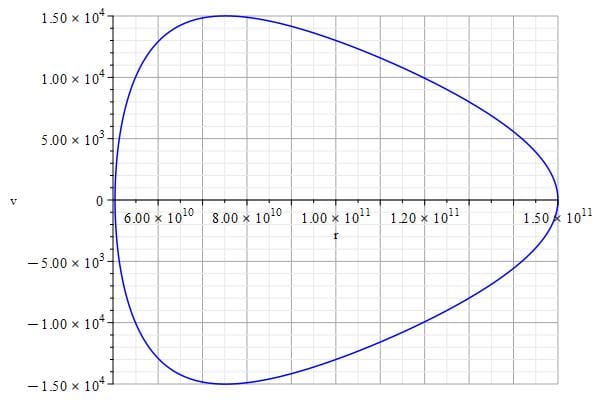
Graph of velocity vs. distance
Earth oscillates back and forth from its initial position but remains captive by the sun
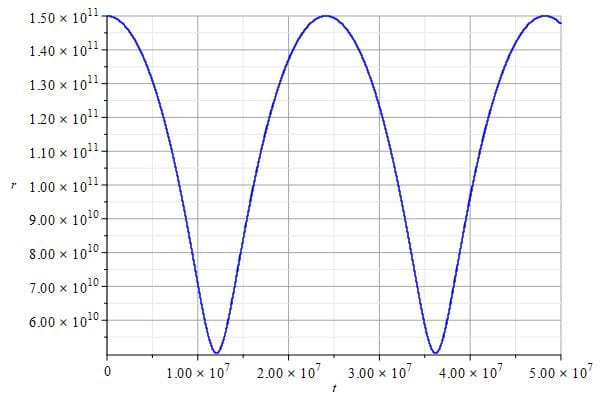
Graph of distance vs. time
Earth oscillates back and forth from its initial position but remains captive by the sun
We see in Fig. 4 that earth oscillates back and forth from its initial position up to a short distance from the sun but remains captive in the system.
Now let’s see what happens if the initial polar angular velocity of the earth was higher when it entered the solar system, say , while keeping the other initial conditions the same as before.
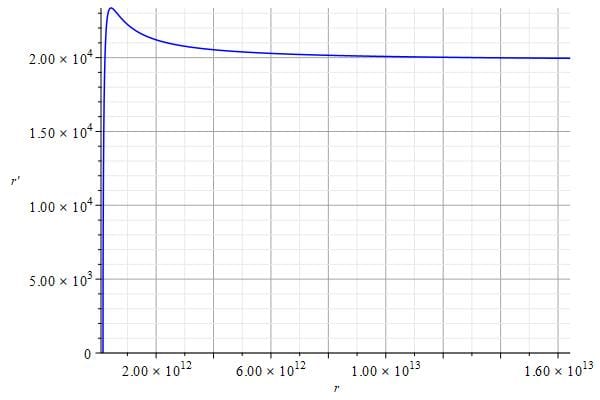
Graph of velocity vs. distance
Earth escapes from the solar system at constant velocity
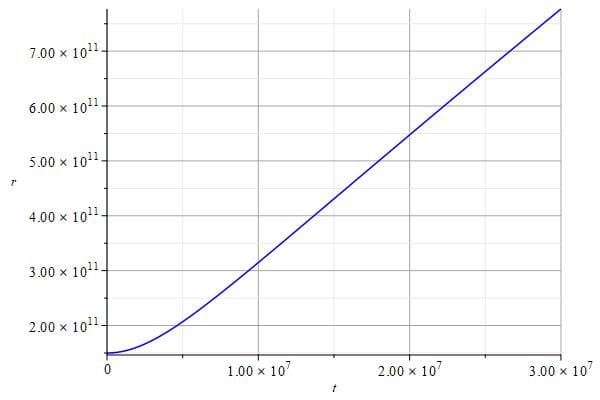
Graph of distance vs. time
Earth escapes from the solar system at constant velocity
As shown in Fig. 5, earth escapes from the solar system until reaching a constant velocity after a certain time. The escaping masses of the spiral galaxies will follow the same velocity pattern from the escaping point onwards.
It is obvious that the behavior of the masses depends on the initial conditions at the moment they start to interact, such as the distance between them and the kinetics of the system.
There is no need to invent such illogical and unphysical things as “dark matter” or “dark energy.” We only need to apply real-world physics.
Conclusions
The universal electrodynamic force served as the foundation for the derivation of the new universal electrodynamic gravitational force and is also the basis to demonstrate the electrodynamics of black holes.
It was demonstrated that the new gravitational force is of electrodynamic origin and that the lump Newtonian mass is not a main quantity, but charge is.
The force of gravity is caused by a high-order neutral dipole oscillation in the bodies, which replaces the old concept of Newtonian mass.
The derived gravitational force contains a new non-radial term that causes several effects, such as quantized orbits, quantized redshifts, and more.
It has been demonstrated that the decay of the gravitational force is due to radiation loss, which causes a decrease in mass.
Since masses are organized in a quantized manner, redshifts will also be quantized.
As hydrogen is the most abundant element in the cosmos, it was demonstrated that the wavelength of the gravitational radiation will mostly fall in the microwave’s spectrum.
The new derived gravitational force clearly explains the so-called “excess of velocity” that apparently happens in the outer arms of spiral galaxies. There is no need to invent such unreal and illogical things as “dark matter” or “dark energy.”
The derivation of the differential equations of motion for the new gravitational force has demonstrated and demystified the “excess of velocity” in the outer arms of spiral galaxies.
It was also demonstrated that the “gravitational lensing” is caused by the interference of the electromagnetic gravitational waves and is easily reproducible in the laboratory. Intergalactic plasma and vacuum have a refractive index of nearly 1, making the effect achromatic. There is no such thing as the unphysical idea of space-time warping.
Bibliography
[1]. Raul Fattore, “Faster-Than-Light Travel Feasible with Negative Mass – Superluminal Dynamics”, (2025)
[2]. Raul Fattore, “Nuclear Fusion Enhanced by Negative Mass – A Proposed Method and Device – (Part 3)”, (2024)
[3]. Charles W. Lucas, Jr., “The Universal Electrodynamic Force” (2011), PROCEEDINGS of the NPA.
[4]. Raul Fattore, “Nuclear Fusion Enhanced by Negative Mass – A Proposed Method and Device – (Part 2)”, (2024)
[5]. Raul Fattore, “New Atomic Model with Real-Valued Wave Function – Energy Levels, Spectrum, and Atomic Fine Structure”, (2026)
[6]. A. K. T. Assis, “Gravitation as a Fourth Order Electromagnetic Effect”, Advanced Electromagnetism: Foundations, Theory and Applications, T. W. Barrett and D. M. Grimes (eds.), (World Scientific, Singapore, 1995). https://www.ifi.unicamp.br/~assis/gravitation-4th-order-p314-331(1995).pdf
[7]. Charles W. Lucas, Jr. “The Electrodynamic Origin of the Force of Gravity”, Part 1 (2008), Part 2 (2009), Part 3 (2009).
[8]. W. J. Hooper, “New Horizons in Electric, Magnetic, and Gravitational Field Theory”, Electrodynamic Gravity, Inc., (1974)
[9]. N. Graneau, T. Phipps Jr, and D. Roscoe, “An experimental confirmation of longitudinal electrodynamicforces”, The European Physical Journal, (2001)
[10]. Tifft, W. G. and Cocke, W. J., “Global Redshift Quantization”, Astrophysical Journal, (1984).
[11]. Napier, W. M. and Guthrie, B. N. G., “Quantized Redshifts: A Status Report”, Journal of Astrophysics and Astronomy, (1997).
[12]. Tifft, W. G., “Redshift Quantization in the Cosmic Background Rest Frame”, Journal of Astrophysics and Astronomy, Volume 18, Issue 4, pp. 415-433, (1997).
[13]. Roscoe, D. F., “An Analysis of 900 Optical Rotation Curves”, International Astronomical Union Symposium, 194, 379-383, (1999).
[14]. Duan, J.-L., Xiao, W., Guo, M., Liu, T., Chen, H. and Chen, J.-H., “Mimicking Symmetry-Breaking Einstein Ring by Optical Lens”. Adv. Photonics Res., 6: 2400203. https://doi.org/10.1002/adpr.202400203, (2025).
[15]. Winston H. Bostick, “The Morphology of the Electron”, International Journal of Fusion Energy, Vol. 3 No. 1, pp. 10-53 (1985), http://wlym.com/archive/fusion/ijfe/19850101-IJFE.pdf
[16]. S. W. Hawking, “Particle Creation by Black Holes”, Communications in Mathematical Physics, (1975)
[17]. Raul Fattore, “Astronomical Distance Measurements Are Wrong – Galaxies Are Far Closer to Earth in Our Much Younger Universe”, (2025)
[18]. Raul Fattore, “Full Free Motion of Celestial Bodies Around a Central Mass – Why Do They Mostly Orbit in the Equatorial Plane?”, (2022)
Related articles
The Electrodynamic Origin of Black Holes (Part 2)
New Atomic Model with Real-Valued Wave Function – Energy Levels, Spectrum, and Atomic Fine Structure
Nuclear Fusion Enhanced by Negative Mass – A Proposed Method and Device (Part 2), (Part 3)